Photo of the week
-
This midweeks photo.
Hurricane Mk.IIb BE485 Coded AE-W, crosses the channel with 250-pound bombs slung under the wings on an intruder sortie into occupied France from No. 402 Squadron RCAF 1941.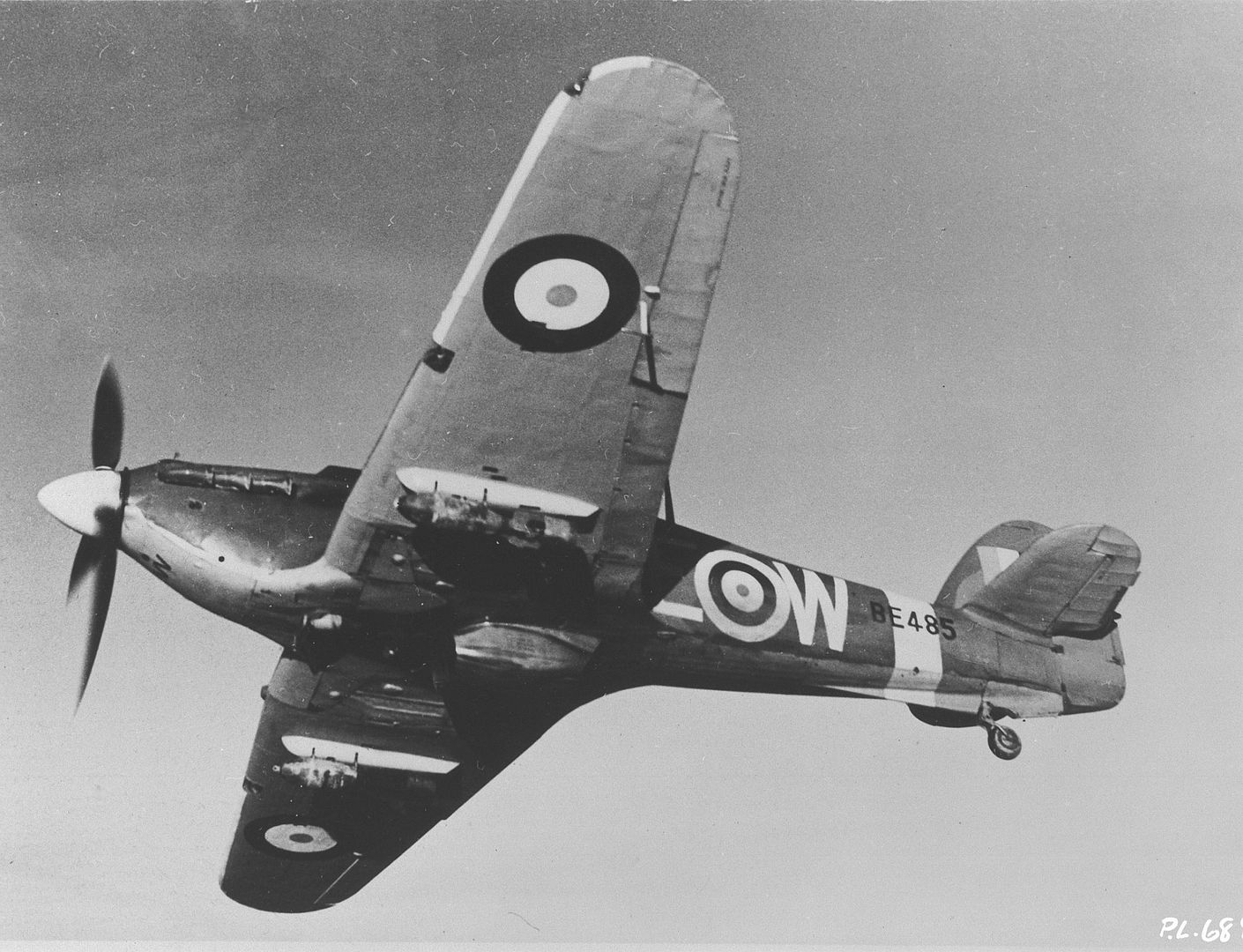
In June 1941 402 Sq, with Hurricane Mk.IIBs, began training to become the first "Hurribomber" unit, commencing operations in this role in November 1941, carrying pairs of 250 lb bombs beneath the wings. -
This weekends photo.
Lieutenant Leder (Designated as Missing in Action (MIA) on June 18, 1944.) and an aircraft mechanic stand on the wing of a Bell P-39D Airacobra fighter from the 35th Fighter Squadron, 8th Fighter Group.
The 35th Fighter Squadron along with the 8th Pursuit Group and 22nd Airbase Group left San Francisco in Convoy Number 2033, escorted by USS New Orleans, for Australia on 12 February 1942 on the Army transport USAT Maui arriving with the convoy at Brisbane, Australia on 5 March 1942. The squadron has never been stationed in the United States since. It arrived in Brisbane, Queensland on 6 March 1942. After arrival, it moved to Amberley Airfield, west of Brisbane, where it was equipped with Bell P-39D Airacobras that were originally intended to go to the Philippines but the convoy carrying them was diverted to Brisbane.
They then moved to Woodstock Airport, Queensland outside of Townsville in northern Queensland on 26 April 1942 on their way to Port Moresby, New Guinea where they arrived on 30 April 1942. There, the squadron operated from a gravel fighter strip constructed by the Australians in the 1930s called Kila Kila Airfield (3 Mile Drome). After two months in combat, the squadron rotated back to Australia, returning to Woodstock on 29 June 1942 for various rest and re-equipment tasks. They relocated to Garbutt Field in Townsville on 27 July 1942 and then moved to Milne Bay in New Guinea on 18 September 1942 after the airfield was secured from the Japanese. It again engaged in combat operations against Japanese forces with its P-39s until rotated back to Queensland, being sent to Mareeba Airfield in February 1943 as its Airacobras were basically worn-out. At Mareeba, the squadron was re-equipped with Curtiss P-40N Warhawks before leaving Australia for good in May and heading back to Port Moresby.
In New Guinea, the squadron covered landings and supported offensive ground operations in New Britain, New Guinea, and Hollandia, with the group moving forward to different bases as territory was captured from the Japanese. At Cape Gloucester, the P-40s were replaced by Lockheed P-38F Lightnings that were ferried up from Australia. It was with the P-38 that the 8th Fighter Group became truly effective both against the Japanese Zero in air-to-air battles, as well as providing ground support to MacArthur's ground forces. Its twin engines offered an additional safety factory when operating over long stretches of water and jungle. The Lightnings proved to be extremely rugged and could take a lot of battle damage and still keep flying. Missions lasting 9, 10, or even 12 hours became routine, and many wounded Lightnings were able to limp home on only one engine.
In 1944, the 35th supported operations in the Philippines, earning a second Distinguished Unit Citation when, armed only with machine guns, the Lightnings of the 8th Fighter Group strafed a Japanese naval task force for three hours, halting the ships until North American B-25 Mitchell medium bombers from more distant bases could attack the task force with low-level bomb runs Despite the fact that the group did not have time to load bombs on its fighters and used only .50 caliber bullets on the mission, the 8th managed to sink one of the Japanese ships.
After moving to San Jose, Occidental Mindoro in the Philippines in December 1944, the 35th spent the next several months conducting offensive operations against Formosa and the Asian mainland, as well as flying escort missions in the area. Moving to Ie Shima Airfield in August 1945, the 8th flew several missions against the Japanese island of Kyushu before the war ended.
On 14 August 1945, the day of the Japanese surrender, the 35th Fighter Squadron shot down the last enemy plane of the war. During its involvement in World War II, the 35th participated in nine campaigns. -
This weekends extra.
Dornier Do 17Z bombers from the 2nd Group of the 77th Bomber Squadron (II./KG77) at the Freux auxiliary airfield in Belgium.
-
This midweeks photo.
And a nice shot of a Fiat G-59-4A.
These were the final versions of the G.59-4A single-seater and G.59-4B two-seater, which were fitted with bubble canopies for improved visibility. 20 G.59-4As and ten G.59-4Bs were produced by Italy. -
This weekends photos
And a couple of air to airs of Handley Page Halifax Mk. VIII PP285, take on the sixteenth of May 1945.

Handley Page Halifax Mk. VIII PP285: Retained by Handley Page for test purposes in overall silver/natural metal finish .The aircraft was retained by Handley Page aircraft for tests and trials of powered flying controls, and reverse pitch propellors.
Written off (damaged beyond repair) 13.2.1948: The crew consisting of pilots and engineers from the manufacturer Handley Page Aircraft was completing a test flight in Radlett. Upon landing, at Radlett Airfield, Radlett, Hertfordshire, an undercarriage leg collapsed. The aircraft went out of control and veered off runway before coming to rest. All four occupants were unhurt while the aircraft was damaged beyond repair.
Wreckage to 58 MU RAF Honington, where scrapped. Struck Off Charge 30.3.48 -
-
This midweeks photos.
And a couple of stunning shots of a Focke-Wulf Fw-190 "Gelbe 5" of Schnellkampfgeschwader 10

Schnellkampfgeschwader 10 (SKG 10) was a Luftwaffe fast bomber wing of the Second World War. The unit was initially created with three Gruppen (groups) in December 1942 at Saint-André-de-l'Eure Airport and augmented by a fourth group on 10 April 1943.
The Stab (headquarters unit) was transferred on 18 October 1943 and formed the core of Schlachtgeschwader 10.
10.(Jabo)/JG 2 and 10.(Jabo)/JG 26 were amalgamated into Schnellkampfgeschwader 10 which initially flew night bombing operations over southern England, operating under the authority of Angriffsführer England under the command of Dietrich Peltz.
The unit suffered heavy casualties from the RAF night fighters. On the night of 16/17 April 1943, four Fw 190s attempting to attack London got lost over Kent. Three of them tried to land at RAF West Malling: Yellow H of 7./SKG 10, flown by Feldwebel Otto Bechtold landed and was captured, his Fw 190 later being evaluated by the RAE at Farnborough; a Fw 190 of 5./SKG 10 flown by Lt. Fritz Sezter landed minutes later. When Setzer realised his mistake and attempted to take off, his aircraft was then destroyed by an armoured car. A third Fw 190 undershot the runway and was destroyed, the injured pilot becoming a POW. A fourth Fw 190 crashed at Staplehurst, killing the pilot.
The II. and III. Gruppe were transferred to Schlachtgeschwader 4 in October 1943, IV. Gruppe was posted to Schlachtgeschwader 10. In December 1942 III./ZG 2 was redesignated III./SKG 10.
The unit was transferred to Italy in July 1943, operating against Allied shipping between Sicily and North Africa, but with occasional audacious raids on Allied airfields.
The I. Gruppe remained in France under the control of II. Fliegerkorps. Due to the lack of regular night fighters in France, it was decided in April 1944 to employ I./SKG 10 on Wilde Sau missions over North Western France and Belgium during full-moon periods. The group's most successful outing was on the night of 3/4 May, when Fw 190s of I/SKG-10 accounted for six victories in the air combat during the night raid against the panzer training center at Mailly-le-Camp.I. Gruppe was put under the control IX. Fliegerkorps in 1944 and operated against the Allied troops during the Normandy Invasion in June 1944. Two Fw 190 pilots of I./SKG 10 were over the landings at dawn on a reconnaissance mission, and claimed four Avro Lancasters shot down.
The I. Gruppe was transferred to Kampfgeschwader 51 where it operated as its III. Gruppe and was officially redesignated as such on 20 October 1944. -
This weekends photos.
A couple of shots of a Messerschmitt Bf 109G-2-R-3 with a 300 Litre belly tank taken at Vrajdebna Bulgaria 1943

-
This weekends extra.
And a nice study of a MIG 3U.(I-230)
In 1942 and 1943, Mikoyan and Gurevich undertook a number of attempts to improve the performance of the MiG 3 fighter, though ultimately none of the modified fighters went into serial production. One of the more notable experimental versions of the MiG-3 was the U variant. In February 1943, OKB-155 was instructed to develop a special air defense variant of the MiG-3 single-engine fighter that would be used by PVO units to intercept high-altitude German reconnaissance aircraft. According to the requirements put forth by the GKO (State Defense Committee), the improved variant (uluchshenniy, improved= U, MiG-3U) was to have a maximum speed of 670 km/h (416 mph), a ceiling of 12,500 meters (41,000 feet), and the ability to reach an altitude of 10,000 meters (32,800 feet) in 13 minutes. In order to meet these specifications, OKB-155 made a number of modifications to the airframe of the baseline MiG-3, such as extending the fuselage and moving the cockpit aft. Moreover, the MiG-3U featured upgraded equipment, including a new radio and an updated oxygen system. A total of six prototypes were built (D-01, D-02, D-03, D-04, D-05, and D-06). The first prototype, D-01, made its inaugural flight on May 31st, 1943, and though the aircraft’s performance fell short of the GKO’s requirements, the prototype did pass state acceptance trials. Shortly thereafter, four of the prototypes were transferred to the PVO’s 12th GIAP for operational testing. The regiment’s MiG-3Us achieved a level of success against the high-altitude Junkers Ju-86s that flew reconnaissance sorties over the Soviet capital. On one mission, a MiG-3U and a Yak-9D came within 1 km (3,300 feet) of a Ju-86 that was flying at an altitude of 13,000 meters (42,650 feet). After several months in service with the 12th GIAP, the MiG-3Us were withdrawn from service, due primarily to the fact that the aircraft were extremely difficult to land. -
This midweeks photo.
Hawker Hurricane MK I's of RAF 73 Sqn, with nearest aircraft being 'D', serial P2569, and; 'J' serial P2575, over France, in April 1940.
In September 1939, 73 Squadron, along with No. 1 Squadron were then posted to North-East France on the outbreak of war as part of the RAF Advanced Air Striking Force. Early in the campaign the squadron controlled the Cherbourg Peninsula, before a move to Rouvres in October.
After the German attack on 10 May 1940, No. 73 provided cover over Allied airfields and bases, falling back as its airfields were overrun by enemy columns. On 17 June 1940 the squadron had withdrawn from France.